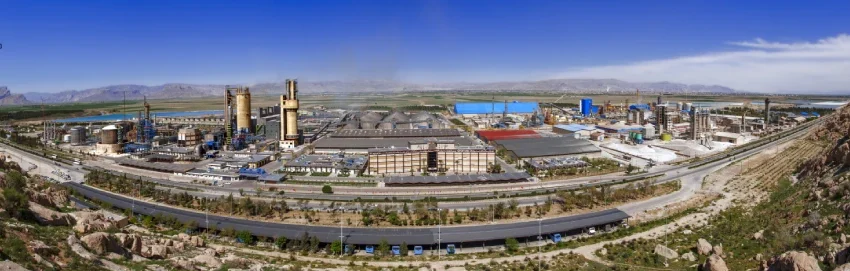
The figures highlight a growing divergence between Shiraz Petrochemical’s revenue growth in local currency and its underlying operating and export performance. September saw a further shift towards domestic sales as export volumes declined sharply, while higher feedstock prices added to pressure on the company’s cost structure. Urea remained the main contributor to revenue, accounting for more than 90% of September sales income.
September production and sales lose momentum
Shiraz Petrochemical produced approximately 196,303 tonnes of products in September 2026 and sold 100,457 tonnes, according to its latest operating report.
Production declined by 20% compared with Mordad, while sales volumes fell by approximately 28%. On a year-on-year basis, production was down 35.6% and sales volumes dropped 59.7%.
Despite the weaker operating performance, the company generated approximately 5.08 trillion tomans in revenue during September.
Sharp decline in exports shifts sales towards domestic market
The most significant change in Shiraz Petrochemical’s September sales mix was the steep contraction in exports.
Export sales fell from 86,786 tonnes in Mordad to 29,908 tonnes in September, a decline of approximately 65.5%.
Domestic sales, by contrast, increased from around 53,000 tonnes to 70,549 tonnes over the same period.
The shift was also reflected in revenue. Domestic sales generated approximately 3.48 trillion tomans in September, while export revenue fell from 4.66 trillion tomans in Mordad to around 1.59 trillion tomans.
As a result, domestic sales accounted for a substantially larger share of the company’s September business, marking a clear departure from its broader export-oriented sales pattern.
Urea accounts for more than 90% of September revenue
Urea continued to dominate Shiraz Petrochemical’s product portfolio and remained its largest source of revenue.
The company sold approximately 89,773 tonnes of urea products in September, accounting for nearly 89% of total sales volume.
Revenue from urea products reached around 4.64 trillion tomans, representing more than 91% of the company’s total monthly revenue.
Domestic agricultural urea was the largest contributor, generating approximately 2.45 trillion tomans. Bulk export urea followed with around 1.41 trillion tomans, while industrial urea generated approximately 591 billion tomans.
Methanol contributed a further 358 billion tomans in revenue during the month.
Feed gas consumption falls as costs nearly triple
Shiraz Petrochemical received approximately 66.8 million cubic metres of sweet natural gas as feed-stock in September.
Consumption was around 7% lower than in Mordad and nearly 11% below the level recorded in September 2025.
However, the price of feed gas rose sharply, increasing from approximately 10,600 tomans per cubic metre to 32,200 tomans, almost three times the previous year’s level.
Consequently, the company’s feed gas bill climbed from approximately 797 billion tomans in September 2025 to 2.15 trillion tomans in September 2026, an increase of nearly 170%, despite lower consumption.
The sharp rise in feedstock costs is a key factor to watch when assessing the company’s margins and profitability in the coming months.
Six-month revenue grows as production and sales contract
During the spring-summer period of 2026, Shiraz Petrochemical produced approximately 1,220,295 tonnes of products, down around 24% from the corresponding period a year earlier.
Sales volumes also declined by approximately 40% to 441,746 tonnes.
Despite the contraction in physical output and sales, operating revenue increased from 18.10 trillion tomans to 23.84 trillion tomans, representing year-on-year growth of approximately 31.7%.
The divergence suggests that higher realised selling prices, changes in the product mix and exchange-rate effects played a greater role in revenue growth than an expansion in production or sales volumes.
Exports account for 45% of six-month revenue
Domestic sales totalled approximately 250,636 tonnes during the six-month reporting period, while export sales reached 191,110 tonnes.
Exports therefore accounted for around 43.3% of total sales volume.
In revenue terms, domestic sales generated approximately 13.10 trillion tomans, compared with 10.73 trillion tomans from exports. Foreign markets consequently contributed nearly 45% of the company’s total six-month revenue.
The figures also highlight a shift in the sales mix during September, when the share of exports fell substantially below the average for the six-month period.
September foreign-currency earnings fall 85% year on year
Shiraz Petrochemical generated approximately $8.85 million in foreign-currency revenue in September, compared with $27.83 million in Mordad and $60.49 million in September 2025.
This represents a decline of approximately 68% compared with Mordad and nearly 85% year on year.
The sharp contraction coincided with a substantial reduction in urea export volumes, highlighting the difference between growth in revenue measured in tomans and the company’s actual foreign-currency earnings.
Six-month foreign-currency revenue falls 33%
The company’s cumulative foreign-currency revenue during the spring-summer period of 2026 reached approximately $85.07 million, down 33.4% from $127.67 million in the corresponding period of 2025.
Foreign-currency expenditure over the same period amounted to approximately $77.84 million, leaving a positive accounting difference of around $7.23 million between reported foreign-currency revenue and expenditure.
However, a substantial portion of the expenditure was classified under the category of “Other”. Without further disclosure, the figure should not be interpreted as a complete measure of the company’s operating foreign-currency costs or its net foreign-exchange position.
Six-month feed gas costs rise more than 150%
The pressure from higher feedstock prices was also evident in the company’s cumulative six-month figures.
Feed gas consumption declined from approximately 422.8 million cubic metres in the corresponding period of 2025 to 388.7 million cubic metres in 2026, a reduction of around 8%.
Despite lower consumption, the value of feed gas used rose from approximately 4.51 trillion tomans to 11.35 trillion tomans, an increase of more than 150%.
The figures underscore one of the central challenges facing Shiraz Petrochemical: generating higher revenue in local currency while dealing with lower sales volumes, weaker export earnings and a substantially higher feedstock bill.
Revenue growth masks mounting operational pressures
Shiraz Petrochemical’s spring-summer 2026 performance presents a mixed picture. Operating revenue increased by nearly 32%, but production fell 24% and sales volumes declined around 40%. Foreign-currency revenue also contracted by approximately 33%, while feed gas costs rose by more than 150%.
The September figures reinforce these trends, with a sharp reduction in exports shifting the company’s sales mix towards the domestic market and urea continuing to account for the overwhelming majority of revenue.
The key question is whether the increase in rial-denominated revenue will translate into stronger and more sustainable profitability. The answer will depend largely on export recovery, international urea prices, feedstock costs and the company’s ability to restore production and sales volumes in the autumn-winter period of the Iranian calendar year.